Distributing Company sells small appliances to hardware stores

Comprehensive Problem | Bailey Distributing Company sells small appliances to hardware stores in the southern California area. Michael Bailey, the president of the company, is thinking about changing the credit policies offered by the firm to attract customers away from competitors. The current policy calls for a 1/10, net 30, and the new policy would call for a 3/10, net 50. Currently 40 percent of Bailey customers are taking the discount, and it is anticipated that this number would go up to 50 percent with the new discount policy. It is further anticipated that annual sales would increase from a level of $200,000 to $250,000 as a result of the change in the cash discount policy. The increased sales would also affect the inventory level. The average inventory carried by Bailey is based on a determination of an EOQ. Assume unit sales of small appliances will increase from 20,000 to 25,000 units. The ordering cost for each order is $100, and the carrying cost per unit is $1 (these values will not change with the discount). The average inventory is based on EOQ/2. Each unit in inventory has an average cost of $6.50. Cost of goods sold is equal to 65 percent of net sales; general and administrative expenses are 10 percent of net sales, and interest payments of 12 percent will be necessary only for the increase in the accounts receivable and inventory balances. Taxes will equal 25 percent of before-tax

 Income

. a. Compute the accounts receivable balance before and after the change in the cash discount policy. Use the net sales (Total sales – Cash discounts) to determine the average daily sales and the accounts receivable balances.

b. Determine EOQ before and after the change in the cash discount policy. Translate this into average inventory (in units and dollars) before and after the change in the cash discount policy.

c. Complete the income statement. |

 | | Before Policy Change | After Policy Change |

 | Net sales (sales – cash discounts) | | |

 | Cost of goods sold | | |

 | Gross profit | | |

 | General and administrative expense | | |

 | Operating profit | | |

 | Interest on increase in accounts receivable

   and inventory (12%) | | |

 | Income before taxes | | |

 | Taxes | | |

 | Income after taxes | | |


 | d. Should the new cash discount policy be utilized? Briefly comment. |

General Business PROJ-598 Contract and Procurement Mgmt COURsE PROJECT

The course project for PROJ598 consists of three parts, which provide familiarization to processes associated with contract and procurement management.

  • Part 1 (PP1) of the Course Project focuses on the first section of the RFP and entails selecting one of the three RFP procurement cases listed under the PP1 section and using the PP1&2 – Course Project RFP template document in the Doc Sharing area to develop information to support section one of the RFP.
  • Part 1 (PP2) of the Course Project entails completing the remaining sections of the RFP by developing a comprehensive document that could be submitted to a vendor.
  • Part 3 (PP3) covers all of the TCOs but touches mainly upon textbook Chapters 9 through 12. You will be required to identify an opportunity through https://www.Fbo.gov and follow the instructions, which are located in the Doc Sharing section.


Part III (PP3)

Assignment: PP1 and PP2 were designed to highlight TCOs A, B, C, D, and E. In terms of textbook coverage, PP1 dealt with material in Chapters 1 through 8. In contrast, PP3 covers all of the TCOs but touches mainly upon textbook Chapters 9 through 12. You will be required to identify an opportunity through https://www.Fbo.gov and follow the instructions which are located in the Doc Sharing section.

This project is to be prepared and submitted in accordance with the guidelines presented below.

Submission Details:

Please submit your PP3 document to the Week 6 Dropbox. Instructions could be found in the PP3 – Formal Proposal Submission in the Doc Sharing section.

Clarification Issues: As a service to everyone in the class, all questions of a clarification nature should be posted in the weekly Q & A  Forum during the week in which your question arises.

Grading: see scoring grid below.

Deadline: PP3 is due by the end of Week 6.

Submit your PP3 assignment to the Week 6 Dropbox.

Scoring:

Cover Page

5

Technical Approach

35

Personnel quals and management approach

35

Past performance and teaming agreements

25

Capabilities and format

25

Total Points

125


Formal Proposal Submission Assignment


Go to the https://fbo.gov


  1. Search for an opportunities within a 90 day period and select any opportunity of your choice
  2. Include the solicitation Number and Contract Award date
  3. Submit a formal written proposal in response to the opportunity that you have selected.


Evaluation Criteria 


Technical merit is substantially more important than price in determining who will be included in the competitive range.  As proposals become more technically equal, price will take on greater significance.  The Government will select the top 3-5 Offers, considering the following evaluation criteria, listed in descending order of importance.


  • Technical Approach
  • Subject Matter Knowledge
  • Key Staff and Other Resources
  • Past Performance
  • Cost


Written Proposal Format and Instructions


Written Proposal Format


Your written proposal must not exceed 25 pages in length and include the items below.


  • 1 Page Cover Letter
  • Technical Approach must not exceed 10 pages
  • Resumes should be provided for the key staff that you are proposing
  • 3 Past Performance references. Each reference must include a point of contact and contact information.
  • Description of any proposed teaming partners and subcontractors
  • Your proposal should evidence your capabilities, as well as your proposed partners’ capabilities. 
  • The format of your entire proposal must use standard margins with the font size greater than 10 points (e.g., 11 point or 12 point font is acceptable) to include all attachments.


Instructions


Please note that there must be no communication with the client regarding this initiative until a selection has been made.  This includes any potential teaming partners and subcontractors.  Failure to do so will result in disqualification.  Any questions or concerns must be addressed to the instructor.


SCI 100 WEEK 3 Nutrition and Fitness Paper

Resources: The text and MyHealthLab®


Write a 700- to 1,050-word paper in which you include the following:


 Explain your current fitness and nutritional habits.·


 Explain some of the health risks associated with obesity.·


 Identify and describe three new fitness habits that you could·


reasonably incorporate into your lifestyle. How could these new


habits improve your health?


 Identify and describe three new nutritional habits that you could·


reasonably incorporate into your lifestyle. How might these


habits improve your health?


 Discuss how each new habit would promote healthy-weight·


management.


 Discuss how each new habit would benefit your health in·


general.


Include at least two peer-reviewed references.


Format your paper consistent with APA guidelines.


Cost of equity or the rate of return that (answer attached)

Cost of equity or the rate of return that VISA’s shareholders ‘require’
In order to estimate the cost of equity for the company VISA, I need to obtain an estimate of the company’s ‘beta’ or systematic risk coefficient, on the annual rate of return on a risk-free investment, and on the expected rate of return on the ‘market portfolio’. You can easily find that information by going to the following web site: http://finance.yahoo.com and insert the name VISA. The beta of the company is reported on that web site. Click on the “key statistics” link on the left hand side of the screen to find the beta and other information.

First find out what is the present Yield to Maturity (YTM) on a US Government bond that matures in one year. That rate is the ‘risk-free rate’.

Next, it is customary to assume that the difference between the expected rate of return on the ‘market portfolio’ and the risk-free rate rate of return is about 7.0%. This is the expression [RM – RF] . So if for example the risk-free rate of interest is, say, 3% per year, than the expected rate of return on the ‘market portfolio’, RM, is 10%. So, multiply the ‘beta’ of VISA Company by 7.0%. That will be the equivalent of VISA’s βj [RM – RF] . Then add to that number the current yield to maturity on a US Government bond [see step (1) above].

The above procedure provides you with an estimate of the rate of return that the shareholders of VISA require on their investment. This rate is called the cost of equity of VISA.

After going through these calculations, PLEASE DESCRIBE IN DETAIL the following information:

1. Show your work you used to obtain the cost of equity for VISA company.
2. Is this cost of equity higher or lower than you expected? The average cost of capital for a firm in the S&P 500 is 10.2 percent. Would you think VISA should have a lower or a higher cost of capital than the average firm?
3. Look up the betas for some of the other companies compared to VISA Company. These are the companies that have a higher or lower discount rate than VISA Company. Using these betas, compute the cost of equity for these firms. How do they compare to VISA Company? Are you surprised that some firms have a higher or lower Cost of equity than VISA Company?
4. How would you go about finding the cost of equity using the dividend growth model or the arbitrage pricing theory for VISA? No calculations is actually needed to do this – just explain how you would go about doing these calculations and explain what kind of additional information you might need.

quiz 1

Question 1 (Multiple Choice Worth 2 points)

A scientist wishes to represent the location of an earthquake in California. Which type of model is most appropriate for this purpose?

[removed] Computer simulation

[removed] Equation

[removed] Graph

[removed] Map


Question 2 (Multiple Choice Worth 2 points)

Which of the following resulted from the growing consensus within the scientific community as to the accuracy of the Big Bang theory?

[removed] New scientific laws were created.

[removed] An older theory was supported.

[removed] Older theories were disproved.

[removed] New problems were considered untestable.


Question 3 (Multiple Choice Worth 2 points)

When a local farmer found oil bubbling to the surface in one of his fields, he reported the information to a group of scientists. After 30 years of experimentation, the scientists develop a new theory about how oil formed beneath this location. How do you know that this information is really a theory?

[removed] The theory proves a scientific law.

[removed] Most of the data were unobservable.

[removed] The theory was developed over time.

[removed] The data describe a natural phenomenon.


Question 4 (Multiple Choice Worth 2 points)

When a scientific investigation produces evidence that does not support the hypothesis, what can you conclude about the investigation?

[removed] A law has been formed.

[removed] A theory remains accurate.

[removed] A theory has been disproved.

[removed] More investigations need to be completed.


Question 5 (Multiple Choice Worth 2 points)

Which type of model is represented in the following image?

A model showing the locations of coal mines in the United States

Public Domain

[removed] Computer simulation

[removed] Graph

[removed] Map

[removed] Small-scale object


Question 6 (Multiple Choice Worth 2 points)

Which of the following statements is true regarding both theories and laws?

[removed] Test problems

[removed] Require consensus

[removed] Lead to hypotheses

[removed] Explain data


Question 7 (Multiple Choice Worth 2 points)

A pair of scientists proposes two different theories to explain the same set of observations. Which of the following best explains the value of these competing theories?

[removed] Competing theories can be a source of new, testable ideas.

[removed] Competing theories are necessary to transform a theory into a law.

[removed] Competing theories generate controversy that helps popularize ideas.

[removed] Competing theories allow scientists to combine the most interesting aspects of both theories.


Question 8 (Multiple Choice Worth 2 points)

Scott stated the following series of observations. Which represents a theory?

[removed] I observed three stars in the sky.

[removed] The stars give off light.

[removed] Light travels at 300,000 kilometers per second.

[removed] Stars are balls of hot gases.


Question 9 (Multiple Choice Worth 2 points)

Which of the following objects would require the use of a large-scale model?

[removed] An atom

[removed] A car engine

[removed] A frog’s heart

[removed] The Mississippi River


Question 10 (Multiple Choice Worth 2 points)

Which best describes how equations are used in science?

[removed] An equation is a type of graph.

[removed] An equation is a type of theory.

[removed] Equations use symbols to represent data.

[removed] Equations show the locations of distant objects.

P16-7 Multiple differences; calculate taxable income; (answer attached

Title

P16-7 Multiple differences; calculate taxable income; balance sheet classification


Sherrod, Inc., reported pretax accounting income of $76 million for 2011. The following information relates to differences between pretax accounting income and taxable income:

1.Income from installment sales of properties included in pretax accounting income in 2011 exceeded that reported for tax purposes by $3 million. The installment receivable account at year-end had a balance of $4 million (representing portions of 2010 and 2011 installment sales), expected to be collected equally in 2012 and 2013.

2.Sherrod was assessed a penalty of $2 million by the Environmental Protection Agency for violation of a federal law in 2011. The fine is to be paid in equal amounts in 2011 and 2012.

3.Sherrod rents its operating facilities but owns one asset acquired in 2010 at a cost of $80 million. Depreciation is reported by the straight-line method assuming a four-year useful life. On the tax return, deductions for depreciation will be more than straight-line depreciation the first two years but less than straight-line depreciation the next two years ($ in millions):

Income Statement

Tax Return

Difference

2010

$20

$26

($6)

2011

20

35

(15)

2012

20

12

8

2013

20

7

13

$80

$80

$0

4. Bad debt expense of $3 million is reported using the allowance method in 2011. For tax purposes, the expense is deducted when accounts prove uncollectible (the direct write-off method): $2 million in 2011. At December 31, 2011, the allowance for uncollectible accounts was $2 million (after adjusting entries). The balance was $1 million at the end of 2010

5. In 2011, Sherrod accrued and expense and related liability for estimated paid future absences of $7 million relating to the company’s new paid vacation program. Future compensation will be deductible on the tax return when actually paid during the next two years ($4 million 2012; $3 million in 2013).

6. During 2010, accounting income included as estimated loss of $2 million from having accrued a loss contingency. The lost is paid in 2011 at which time it is tax deductible.

Balances in the deferred tax asset and deferred tax liability accounts at January 1, 2011, were $1.2 million and $2.8 million, respectively. The enacted tax rate is 40% each year.

Required:

1.Determine the amounts necessary to record income taxes for 2011 and prepare the appropriate journal entry.

2.What is the 2011 net income?

3.Show how deferred tax amounts should be classified and reported in the 2011 balance sheet.


counting atoms for dickson only

Counting Atoms

Write the number of each type of atom in the following chemical formulas.


1.    NaCl   
2.    H2SO4             
3.    KNO3 
4.    CaCl2                    
5.    C2H6               
6.    Ba(OH)2                     
7.    NH4Br             
8.    Ca3(PO4)2                            
9.    Al2(SO4)3                               
10. Mg(NO3)2

Sound and Light Review

1) In what units do we measure the loudness or intensity of sound? This is a logarithmic scale, why is this type of scale used?

2) What are several common uses for microwaves?

3) Explain why smooth surfaces make clear images and rough surfaces do not.


here is the material to find the answers.

Refraction of Light
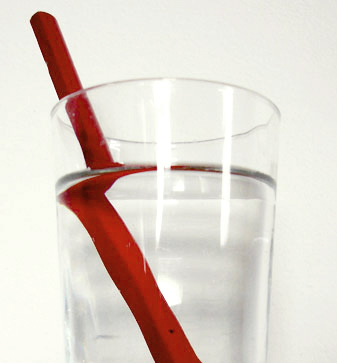
Refraction is the bending of waves as they pass from one medium to another due to a change in the speed of the wave. This can cause images to appear to be in different locations. Waves can also change speed and bend when they pass through areas of different temperatures, causing a mirage. 


The refraction of light bouncing off of the stick as the rays move from the water to the air causes the stick to appear to be broken.


Dispersion
Because different colors of light have different wavelength, they are refracted different amounts. This causes dispersion when multi-colored light changes mediums, breaking the light into its component colors. This is how rainbows are formed. As light passes through water in the air, the light rays are dispersed into all of the visible colors. 
This rainbow is caused by the refraction and dispersion of white light into its 7 colors. 
 
Lenses
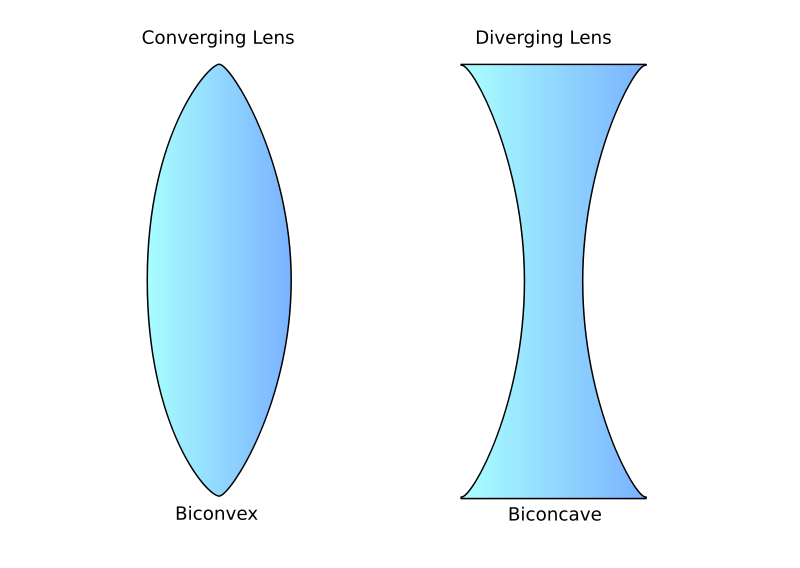
A lens is an object through which light rays pass. As they pass through the light rays bend due to refraction. There are two types of lenses:
  • Converging or Convex Lens – In a lens like this the sides bend outwards. These cause the light rays to come together as they pass through the lens.  These are often used as magnifying glasses.
  • Diverging or Concave Lens – These lenses have sides that bend inwards. These cause the light rays to diverge, or spread apart as they pass through the lens.
 
The two most common lenses are biconvex (equal curvature on both sides) and biconcave.
 
Both types of lenses can be used in camera lenses, telescopes, and to correct vision with glasses or contacts. 
 
 
Click HERE to read about how the development of the telescope was dependent on mirrors and lenses.