EDU 367 Elementary & Secondary School Media

Best Practices for a Library Media Center
You have been learning about best practices for today’s library media manager. You have examined the role of technology in the school library and how this has changed the way students use libraries.

Reflect on the course curriculum over the past five weeks. In an eight- to ten-page paper, develop a plan for a library that uses a range of programs and technologies. Include the following components in your paper:

1. At least three different programs and three different technologies, and an explanation of your rationales for selecting those programs and technologies
2. An explanation of how the role of the librarian/library media manager has changed
3. An explanation of the characteristics of an effective librarian/library media manager
4. An explanation of how a librarian/library media manager is a collaborative partner with the classroom teacher
5. An explanation of how the school librarian/ library media manager uses technology to the advantage of teachers and students
6. An explanation of how the librarian/library media manager uses library lessons to include technology and meet the needs of a diverse population
Within the context of your paper, cite at least three resources using proper APA format.

Writing the Final Paper

The Final Paper:

1. Must be eight to ten double-spaced pages in length, and formatted according to APA style as outlined in the Ashford Writing Center.
2. Must include a title page with the following:
a. Title of paper
b. Student’s name
c. Course name and number
d. Instructor’s name
e. Date submitted
3. Must begin with an introductory paragraph that has a succinct thesis statement.
4. Must address the topic of the paper with critical thought.
5. Must end with a conclusion that reaffirms your thesis.
6. Must use at least three scholarly sources.
7. Must document all sources in APA style, as outlined in the Ashford Writing Center.
8. Must include a separate reference page, formatted according to APA style as outlined in the Ashford Writing Center.

M3_A1: Discussion—Behavioral Heuristics

Behavioral heuristics, such as availability, anchoring, vividness, storage, conjunction fallacy, and representativeness, all reflect behavioral traits, which if left unchecked may lead to systematic bias in the choices you make. For example, anchoring and availability can lead to disastrous decisions.

You may know how to recognize these heuristics, but consider how they may have influenced you in the past.

Find at least one example from your own career where you, or another manager, allowed one of these or another pitfall, to sway you from the mean.

Respond to the following:

  • Why did you/they ignore the base rates?
  • What other statistically relevant factors did you/they fail to incorporate?
  • How could you have altered the framing of the situation to make a better decision?

Write your initial response in approximately 300 words. Apply APA standards to citation of sources.

By Wednesday, June 17, 2013, post your response to the appropriate Discussion Area.  Consider the following points in your comments:

  • What other traps may have influenced the situation in their posts?
  • How would you have framed the problem differently?
  • Are there any other creative solutions to reduce the systematic bias?
 
 
Assignment 1 Grading Criteria
Maximum Points

Initial response:

  • Was insightful, original, accurate, and timely.
  • Was substantive and demonstrated advanced understanding of concepts.
  • Compiled/synthesized theories and concepts drawn from a variety of sources to support statements and conclusions.


16

Discussion response and participation:

  • Responded to a minimum of two peers in a timely manner.
  • Offered points of view supported by research.
  • Asked challenging questions that promoted the discussion.
  • Drew relationships between one or more points in the discussion.


16

Writing:

  • Wrote in a clear, concise, formal, and organized manner.
  • Responses were error free.
  • Information from sources, where applicable, was paraphrased appropriately and accurately cited.


8
Total:
40


HCA270 week 9 Final Project

Create a 12- to 15-slide Microsoft® PowerPoint® in which you outline the following areas of financial concern and conclude with your decision on whether you would recommend EMRs to the stakeholders. Include detailed speaker notes.

Information technology has enhanced operational activities throughout the health care industry. Much has been discussed in financial analysis, price, and acquisition discrepancies. The decision to acquire and implement technology, and justify the cost has perplexed physicians and health care facilities.


Assume you are an office manager in a physician’s group practice. As the office manager, you have been asked to review and explain the financial implications of implementing electronic medical records (EMR). You will address potential areas of financial concern and provide your recommendation to the physician’s group on whether or not to implement EMR.


Create a 12- to 15-slide Microsoft® PowerPoint® in which you outline the following areas of financial concern and conclude with your decision on whether you would recommend EMRs to the stakeholders. Include detailed speaker notes. Cite at least three outside sources and your textbook. Discuss the following areas with the focus on the financial aspects:


·        

Implementation process; This should be your introductory slide.


o  

Why implement?


o  

What is involved?


·        

Financing technology; Choose at least five.


o  

Capital expenditures


o  

Opportunity costs


o  

Budgeting, cash flow


o  

Depreciation


o  

Present value


o  

Payback


o  

Projected revenue


o  

Overall costs


·        

Costs not considered in the implementation process; Choose at least two.


o  

Threat of litigation


o  

Layout of facility


o  

Life expectancy and value of the equipment


o  

Maintenance


o  

Increase in operational costs


·        

Financial incentives for implementing new forms of technology: Choose at least one.


o  

Government, as in Medicare reimbursement


o  

Health care professional societies


o  

Health plans, as in pay-for-performance programs


o  

Quality improvement agencies that may offer financial incentives, such as the National Committee for Quality Assurance, the Utilization Review Accreditation Committee, or the Joint Commission


·        

Advantages and disadvantages


·        

Final recommendation


Format your presentation consistent with APA guidelines:


·        

Title slide


·        

Introductory or overview slide


·        

Slides presenting the information required for the assignment


·        

Detailed speaker notes with in-text citations


·        

Recommendation or summary slide


·        

Reference slide


Post your final project as an attachment.


HCA/270 Week 9 Implementing EMR

HCA 270 Week 9 Implementing EMR PPT

HCA 270 week 9 Final Project Implementing EMR

HCA270 week 9 Final Project Implementing EMR

HCA/270 week 9 Final Project Implementing EMR


PowerPoint Presentation HCA 270 week 9 Final Project Implementing EMR

FOR A-PLUS WRITER ONLY

The MATERIAL NEEDED:


 Hey, about that acquisition we discussed last week—it seems that we aren’t going to get anywhere with this IS merge until we provide top management with a plan for strategic decision-making. I’m stuck in executive committee meetings all week so I need you to put together some information for the CEOs.


I need you to determine who from our company and Wing should be involved in IS decisions. I don’t need specific names right now but just give me the departments and personnel level that should be included and the rationale behind those choices. We will need to establish some kind of process for how IS decisions should and will be made. There is probably some technology in the picture as well.


In fact, the CEOs were asking if decisions will be made using information from the existing IS. They also want to know the pros and cons for using technology for decision-making. I think we’d better also tell them how often strategic plans should be reviewed as well as how we will determine which plan to implement.


Do what you can to get these issues wrapped up this week. You can try catching me on my cell phone or by email if needed but I will be tied up in meetings all week so my response may be delayed. I’m counting on you—I have no doubt you can handle this without me. Thanks.


The CIO has given you quite a challenge, and he’s going to be too busy to help you with any advice. You have a lot to do and you have only a week!


To complete your task, you will have to answer the questions: How do businesses make decisions? What kinds of information do they need in order to make decisions? Let us first consider personal decisions and the information needed to make those. For example, suppose you are trying to make a decision about a purchase for your home. You would begin with reviewing your finances. You will need to know exactly how much you make and how much you spend. Your bank statement is a good source of this information. Each bank customer receives a spreadsheet with information on the breakdown of their expenses and deposits, which they can use to review their finances. Next, let us think about how the bank keeps track of information on each of its customers. Banks use a computer application to record and generate information. All customer transactions are recorded and stored in a database. The bank can retrieve selected data and organize it according to customer specifications using a report generator application.


Let us get back our example on the purchase decision you are making for your home. After using your bank statement to analyze information on your income and expenditure, you will have a good idea whether you can purchase what is on your wish list or your needed list. You will also be able to make adjustments to facilitate purchases. Businesses follow a similar process to make decisions about their purchasing needs or wishes


After you break down decision-making into steps, the process no longer seems daunting. The same idea applies in the world of IT, or any other organizational decision-making. First, you need to gather information on what you have, what you need, and how the work can be done quicker and better. In your analysis, you also need to remember that sometimes, you can do things quicker but not necessarily better and if it is not better, you are likely to lose customers.   (Page 1)


STR 581 Exam

Some studies indicate the best approach for transformational change may have the chief executive officer create an atmosphere for change and establish a reward system but let others decide how to initiate change but carefully set limits for the program and begin establishing a vision


Which of the following statements is true with regard to the effectiveness of tactics?


·        The combination of a soft tactic with reasonable persuasion is more effective than a combination of two hard tactics.


·        Soft tactics are less effective than hard tactics when used individually


·        Individuals from collectivist cultures are typically more likely to use soft tactics that reflect personal power.


·        All tactics are equally effective with regard to upward influence.


Sam Meyers manages a telemarketing call center. He has 20 employees working for him who are displeased with the way he yells and threatens to terminate them for what they see as small issues. Which kind of power is Sam using to get the job done?


·        Reward power


·        Legitimate power


·        Coercive power


·        Referent power


Training that results in ______ is costly because of the cost of training (which proved to be useless) and the cost of hampered performance.


·        reinforcement of training


·        applicability of training


·        negative transfer of training


·        simulation of training


Deming’s PDCA (plan, do, check, and act) cycle underlies what inherent Six Sigma principle?


·        Continuous improvement


·        Standard deviation


·        Project management


·        Control charting


Which of the following is an element that addresses elimination of waste under lean production?


·        Minimized run times


·        Production ahead of demand


·        Group plant loading technology


·        Kanban production control system


Conflicts can be resolved by withdrawing from them or suppressing them. This conflict-management technique is known as ________.


·        forcing


·        compromising


·        avoiding


·        accommodating


Which of the following is a desirable strategy for managers aiming to reduce the negative consequences of rumors?


·        Refusing to comment on issues that appear to be controversial and unfair


·        Creating a more informal communication environment at the workplace


·        Initiating disciplinary action against the employee who started the rumor


·        Encouraging employees to communicate their concerns and suggestions


A project can be segmented into which of the following?  


·        Events


·        Success markers


·        Sub-jobs


·        Work packages


Because practical considerations make job tryouts for all candidates infeasible, it is necessary to __________ the relative level of job performance for each candidate on the basis of available information.


·        abandon


·        predict


·        accept


·        assign


Which of the following is one of Dr. Eli Goldratt’s rules of production scheduling for optimized production technology? 


·        Do not allow bottlenecks to govern the flow of the line.


·        An hour saved at a bottleneck operation does not increase the process flow.


·        If you lose an hour at a bottleneck it is better than making scrap.


·        Utilization and activation of a resource are not the same


When an employee volunteers to run a canned food drive, this is an example of


·        job satisfaction


·        organizational citizenship behavior


·        employee happiness


·        employee productivity


In order to make their firm a learning organization, managers should


·        reinforce interdependence and reduce boundaries


·        avoid the use of cross-functional teams


·        increase the degree of departmentalization


·        penalize mistakes


The concept that some leadership attributes will work in some situations but not in others can be described by the


·        behavioral theory


·        contingency theory


·        tactical theory


·        leadership effectiveness theory


In _____, workers have been fired for refusing to quit smoking, for living with someone without being married, drinking a competitor’s product, motorcycling, and other legal activities outside of work.


·        lifestyle discrimination


·        defamation


·        invasion of privacy


·        constructive discharge


According to the job characteristics model, autonomy is defined as the degree to which 


·        a job provides the worker freedom, independence, and discretion


·        a job has an impact on the lives or work of other people


·        a job generates direct and clear information about performance


·        a job requires completion of a whole and identifiable piece of work


In performing a SWOT analysis, which of the following would be considered as a threat?


·        Increased product demand


·        Recognized brand


·        Competitors


·        Lack of a strategic plan


As a university student, your institution’s social principles and practices reflect on you, as a stakeholder, in the organization. Therefore, it is your right to question how these practices should be evaluated in relation to the social issues that the school is addressing. If your university provides job-share programs, builds a day-care facility, and only uses recycled paper, it could be said to be ________.


·        socially image conscious


·        fulfilling its social obligation


·        socially aware


·        socially responsive


Which of the following is ISO 14000 primarily concerned with?


·        Continuous improvement management


·        Time management


·        Quality management


·        Environmental management


During the implementation of a project, which of the following should be the primary focus of a consulting firm?


·        The correct project software


·        People management skills


·        Tools and materials availability


·        Application of the learning curve theory


What can affirmative action assist organizations in achieving that diversity initiatives cannot?


·        Correcting specific problems of the past


·        Increased productivity


·        Maximizing creativity


·        Maximizing workforce commitment


The Civil Rights Act of 1991 offered what for victims of unintentional discrimination?


·        affirmative action


·        adverse impact


·        race norming


·        monetary damages and jury trials


Adoration of a charismatic leader by followers can lead to 


·        greater understanding of the company mission


·        difficulty in developing a successor


·        a competitive work environment


·        limiting suggestions of fixes and improvements


An example of control criteria that can be used in any situation is ________.


·        number of calls taken per day


·        client requests completed per hour


·        employee satisfaction


·        average time to process paperwork.


Mary arrives at her new job. Before she can begin actually doing the work, she must complete a series of activities including role playing and virtual reality interactions.  What type of training method does Mary’s new employer use?


·         Information presentation


·        On-the-job training


·        Simulation


·        Organizational development


Project Result

 reply to the q1 below

Definition:
Project scope is defined as, “The end result or mission of your project-a product or service for
your client/customer” .
Summary:
In an article about project failures the author, Jed Simms, breaks down these failures into two
articles the first, poor business requirements and the second wrong scope. In the article indicating
that project fail because of wrong scope the author tells of two companies who trying to
minimize their project scope thus minimizing the workload. Upon completion of the projects
both companies, “Wished they had not minimized the scope and had ‘done the job properly’” .
Discussion:
Reading this article reiterated what the textbook already stated only in a real world scenario. The
textbook said, “Research clearly shows that a poorly defined scope or missions the most frequent
mentioned barrier to project success” . Getting the scope correct from the beginning is not only
the first step in defining the project, but can make a huge difference in the outcome of the project
when it is completed. The author says this in his article states minimizing the scope may reduce
the project’s cost, but the focus should be on the net value .Having the right project scope will
also keep the project team on track with good planning and also will be able to measure its
success upon completion.
References and Articles:
Clark, K. (1989). Project Scope and Projec Performance: The Effect of Parts Strategy and
Supplier Involvement on Product DevelopmentManagement Science, 1247-1263.
Khan, A. (2006). Project Scope Management. Cost Engineering, 12-16.
Larson, E., & Gray, C. (2011). Project Management: The Managerial Process. New York:
McGraw Hill.
Simms, J. (2007, June 19). Why Projects Fail: Part One, Wrong Scope. Retrieved from CIO:
http://www.cio.com.au/article/204935/why_projects_fail_part_one_wrong_scope/

HRM 532 Assignment 2 Avon Case Study

Assignment 2: Avon Products or GE Money America Case Study
From the Goldsmith & Carter textbook, select either the Avon Products (Chapter 1) or GE Money Americas (Chapter 6) case study for this assignment.

Write a five to seven (5-7) page paper in which you:


  1. Provide a brief description of the status of the company that led to its determination that a change was necessary.
  2. Identify the model for change theory typified in the case study of your choice. Discuss what led you to identify the model that you did.
  3. Illustrate the types of evaluation information that were collected and how they are used to benefit the company.
  4. Speculate about success of the changes within the next five (5) years and how adjustments could be made if the results become less than ideal.
  5. Use at least five (5) quality academic resources in this assignment. Note: Wikipedia and other Websites do not quality as academic resources.


Your assignment must follow these formatting requirements:


  • Be typed, double spaced, using Times New Roman font (size 12), with one-inch margins on all sides; references must follow APA or school-specific format. Check with your professor for any additional instructions.
  • Include a cover page containing the title of the assignment, the student’s name, the professor’s name, the course title, and the date.
  • The cover page and the reference page are not included in the required page length.


The specific course learning outcomes associated with this assignment are:


  • Explore how to identify and develop high-potential talent.
  • Analyze behavior change theories and their impact on talent management processes.
  • Determine the effects of leadership in the management of talent pools and the talent review process.
  • Use technology and information resources to research issues in talent management.
  • Write clearly and concisely about talent management using proper writing mechanics.


hrm 595 devry unversity

The purpose of the negotiation analysis paper is to help you transfer the negotiation concepts from the course to negotiations in your own organization. I would like you to use concepts learned in the course to analyze a negotiation situation. The negotiation may be one that has recently concluded or one that you are in the midst of. It may be a negotiation between organizations or within an organization. It may be a dyadic negotiation or one with multiple parties. It may be a situation of chronic conflict. It also may be a negotiation in which you observed and are familiar with the parties to the negotiations in order to conduct an analysis.

 
Guidelines
  • Paper (due in Week 7) must conform to APA format and be 13–15 pages in length, not including the title page, abstract and references.
  • Spend no more than three pages describing the situation.
  • Negotiation should be complex enough to challenge your analytic skills.
  • Topic proposal due in Week 3 (one page).

Milestones:

  • Week 3 – The proposed topic for the project paper is due in Week 3 (20 points). The proposal should be an explanation of the chosen negotiation topic, the parties to the negotiation, and proposed areas of analysis including negotiation strategies and tactics used. The proposal should be one page.
  • Week 7 – Final completed paper is due (130 points)
 
Grading Rubrics

HRM595 NEGOTIATION SKILLS TERM PAPER

Total Points – 130

Criteria for Evaluating Written Assignments

Meets Expectations

Partially Meets Expectations

Fails to Meet Expectations

Points Earned

Intellectual Understanding

(20 Points)

Addresses all aspects of assignment in sufficient depth

Addresses most aspects of assignment in sufficient depth Does not address most aspects of assignment and/or fails to do so in sufficient depth  

Creativity

(20 Points)

Analyzes and discusses many negotiation concepts by extending and elaborating with realistic examples

Discusses with some analysis several negotiation concepts by extending and elaborating with realistic examples Does not discuss negotiation concepts or apply them to realistic examples  

Insight

(20 Points)

Exhibits a substantive and perceptive ability in analyzing and discussion negotiation topic that is the focus of the paper

Discusses assignment topic with some substance and evidence of perceptive ability Does not exhibit perceptive ability in discussing the assignment topic  

Validity

(20 Points)

The majority of opinions and analyses are rigorously supported by appropriate research.

Some opinions are supported by appropriate research but much is not supported The majority of opinions and analysis is not supported by appropriate research  

Intellectual Honesty

(20 Points)

All references are acknowledged and properly cited in APA format

Some references are acknowledged and properly cited in APA format References are not properly acknowledged and cited and/or do not conform to APA format  

Organization and Style

(30 Points)

Introduction – Central theme/purpose is clearly identifiable and well developed; introductory comments provide sufficient background on the topic and preview major points Introduction – Either the central theme/purpose is clearly identifiable and well developed; or the introductory comments provide sufficient background on the topic and preview major points, but not both Introduction – Central theme/purpose is not clearly identifiable nor well developed; introductory comments do not provide sufficient background on the topic nor preview major points  
  Conclusion and recommendations follow logically from the body of the paper and bring closure to the paper Conclusion and recommendations follow logically from the body of the paper but rather than bringing closure to the paper, it merely summarizes what has been previously stated Conclusion and recommendations do not follow logically from the body of the paper nor do they bring closure to the paper  
  Subsequent sections develop/support the central theme of the paper The majority of the subsequent sections develop/support the central theme of the paper Subsequent sections do not develop/support the central theme of the paper  
  Structure is clear, logical, and easy to follow; smooth transition between paragraphs which help maintain the flow of thought Usually the structure is clear, logical, and easy to follow, with smooth transitions between paragraphs to help maintain the flow of thought Sometimes the structure is clear, logical, and easy to follow; seldom includes smooth transitions between paragraphs to help maintain the flow of thought  
  Meets minimum assigned length   Does not meet minimum assigned length  
  No major errors in spelling, punctuation, and grammar Few errors in spelling, punctuation, and grammar Numerous errors in spelling, punctuation, and grammar  
  Paper is laid out effectively – uses headings and other reader-friendly tools Paper is laid out effectively, but could make better use of headings and other reader-friendly tools Paper is not laid out effectively; fails to use headings and other readerfriendly tools  
 

Paper is professional in appearance and demonstrates attention to detail; tone of voice is appropriate to the audience, content, and assignment

Paper is professional in appearance and demonstrates attention to detail; but tone of voice is inappropriate to the audience, content, and assignment Paper is not professional in appearance and demonstrates a lack of attention to detail; tone of voice is inappropriate to the audience, content, and assignment  


Best Practices

xx

The following are the best practices in preparing this paper:

  • Title Page – Include who you prepared the paper for, who prepared, and date.
  • Table of Contents – List the main ideas and section of your paper and the pages in which they are located. The illustrations should be included separately.
  • Introduction – Use a header on your paper. This will indicate you are introducing your paper.

The purpose of an introduction or opening:

1. Introduce the subject and why the subject is important. 
2. Preview the main ideas and the order in which they will be covered. 
3. Establish a tone of the document.

Include in the introduction a reason for the audience to read the paper. Also, include an overview of what you are going to cover in your paper and the importance of the material. (This should include or introduce the questions you are asked to answer on each assignment.)

  • Body of Your Report – Use a header titled with the name of your project. Example: “The negotiation between Company X and Company Y; An Analysis”. Then proceed to break out the main ideas. State the main ideas, state major points in each idea, and provide evidence. Break out each main idea you will use in the body of your paper. Show some type of division, such as separate sections that are labeled, separate groups of paragraphs, or headers. You would include the information you found during your research and investigation.
  • Summary and Conclusion – Summarizing is similar to paraphrasing but presents the gist of the material in fewer words than the original. An effective summary identifies the main ideas and major support points from the body of your report. Minor details are left out. Summarize the benefits of the ideas and how they affect the tourism industry.
  • References – Follow APA Publications Manual, 6th edition in using in-text citations and include a reference page.

Additional hints on preparing the best possible project:

4. Apply a three step process of writing (plan, write, and complete). 
5. Prepare an outline of your research paper before you go forward. 
6. Complete a first draft and then go back to edit, evaluate, and make any changes required. 
7. Use visual communication to further clarify and support the written part of your report. You could use example like graphs, diagrams, photographs, flowcharts, maps, drawings, animation, video clips, pictograms, tables, and Gantt charts if applicable.


operations management

Question #1

T&D electric manufactures high-voltage switches and other equipment for electric utilities. One line that is staffed by three workers assembles a particular type of switch. Currently the threes workers have fixed assignments; each worker fastens a specific set of components on the switch and passes it downstream on a rolling conveyor. The conveyor has capacity to allow a queue to build up in front of each worker. The bottleneck is the middle station with a rate of 11 switches per hour. The raw processing time is 15 minutes. To improve efficiency of the line, management is considering cross-training the workers and implementing some form of flexible labor system.


a)      What is the critical amount of WIP that is needed by this line?

b)      If the current throughput is 10.5 switches per hour with an average WIP level of 7 jobs what is the average cycle time?

c)      What is the practical worst case throughput of the line?

d)     Is there any room for improvement on this line?

Question #2

Floor-On, Ltd., operates a line that produces self-adhesive tiles. This line consists of single-machine stations and is almost balanced (i.e., station rates are nearly equal). A manufacturing engineer has estimated the bottleneck rate to be 2200 cases per 16-hour day and the raw process time to be 30 minutes. The line has averaged 1,500 cases per day, and cycle time has averaged 5 hours.


a)      What is the estimated average WIP level?

b)      How does the performance of the average throughput compare to the practical worst case throughput?

c)      What would happen to the throughput of the line if we increased the capacity of bottleneck station and held the WIP at its current level?

d)     If after process improvements the ten machines that required ten workers to run them are no longer needed. Instead five workers are now needed what would you do with the remainder of workers not working on that line anymore? (And please don’t fire them)


His


HIS 101 and 111 Pre-History Paragraph Assignment


Lascaux
 

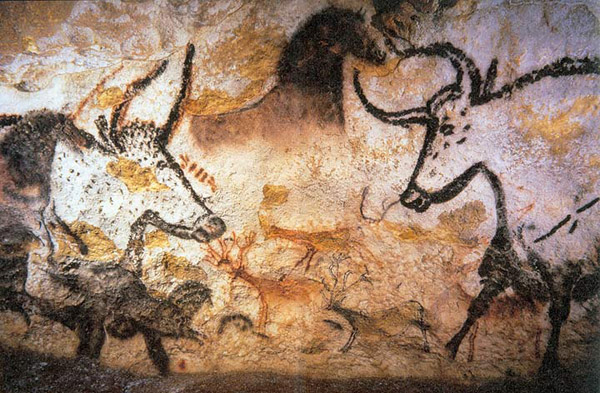
Estimated to be 16,000 years old, this is an image from the Lascaux Cave in Southwestern France near the village of Montignac.  Four teenage boys discovered the cave in September 1940, and for about a decade the site was a major tourist attraction, but the cave was closed to visitors in 1963 in an effort to preserve the fragile ecology of the cave.  It has been a real struggle for the French to preserve the cave and its images intact.  See The Cave of Lascaux.  There is now an exact duplicate available for visitors.  Most of the drawings in the cave are of large animals, and most of the drawings are arranged in comic-strip fashion, from left to right, to tell the story of successful hunts.  Photo Credit.

 Red Separator Bar  After reading the textbook assignment for this unit, write a paragraph that answers the following question:

According to the textbook, what were some of the characteristic phases of development of pre-“historical” humanity? (Please make sure that you read the short notes on “pre-history” first.) Your paragraph should be about one-half page in length, double-spaced with one-inch margins, font size 10 or 12; it should contain a concise topic sentence that directly responds to the assigned question.  Since you are using your own words to summarize the information in the textbook in this assignment, you do not have to use quotes or page citations